
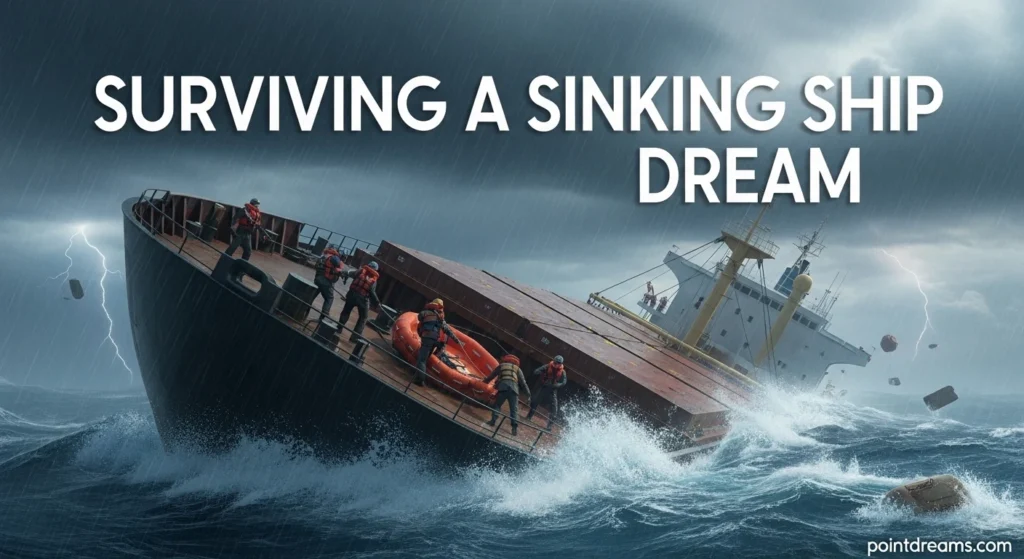
You are standing on a ship in the middle of dark water. The deck beneath your feet shifts, water begins to rush in, and the once-strong vessel that carried you now feels fragile and uncertain. People around you may be shouting, waves may be rising, and the horizon may seem far too distant. Yet in the dream, something remarkable happens: instead of being consumed by fear, you survive. You hold on, you endure, and somehow you make it through the sinking. When you wake up, the image remains—not just as a frightening scene, but as a question. What was your mind trying to tell you? And what might faith have to do with it?
Dreams of surviving a sinking ship can be deeply unsettling, but they are also rich with meaning. In a biblical context, ships often symbolize journeys, missions, testing, and trust in God through dangerous waters. Sinking, meanwhile, can point to instability, loss, transition, or the collapse of what once felt secure. Surviving the sinking does not simply mean escaping danger. It can also reflect spiritual endurance, God’s sustaining hand in crisis, and the quiet formation of faith when life feels unsteady.
Understanding this dream matters because it often appears during seasons when people feel overwhelmed, spiritually tested, or emotionally adrift. The image may not predict disaster. Instead, it may reveal how faith is being refined in the middle of uncertainty.
The Biblical symbolism of ships and water
Ships in dreams carry a powerful symbolic weight because they are vessels of movement, trust, and direction. In biblical imagery, water often represents chaos, mystery, testing, or the unknown. A ship moving across water suggests a life journey in progress. It can reflect calling, purpose, ministry, relationships, or personal development. When that ship begins to sink, the symbol becomes more intense: something that once carried you forward is no longer stable.
In Scripture, water is rarely a neutral backdrop. It often marks moments of dependence on God. Storms test faith. Floods reveal fear. Crossing waters becomes an image of transition and deliverance. A sinking ship in a dream can therefore symbolize a season when what you relied on is no longer enough. The vessel may represent a plan, relationship, identity, or system of support that is failing under pressure.
The ship as a life structure
The ship can symbolize the framework that has supported your journey so far.
The water as emotional or spiritual uncertainty
The surrounding water often reflects circumstances beyond your control.
Sinking as collapse
When the ship sinks, the dream may show that old structures are breaking down.
This symbolism does not always point to destruction. Sometimes it points to a necessary stripping away so that faith can grow deeper than comfort.
What it means to survive in the dream

The most important part of the dream is not only that the ship sank, but that you survived. Survival changes the entire meaning. It suggests endurance, mercy, and the possibility that what felt like an ending was not the end at all.
From a biblical point of view, survival often carries the mark of divine preservation. Many biblical stories involve people passing through danger and emerging alive because God sustained them. Surviving a sinking ship in a dream can therefore reflect a season where your faith is being tested, yet you are not abandoned.
Surviving as spiritual resilience
The dream may show that your spirit is stronger than the crisis you are facing.
Surviving as divine mercy
It may symbolize a sense that you were carried through something that could have overwhelmed you.
Surviving as transformation
Sometimes survival does not mean returning to who you were. It means becoming someone new through the trial.
The dream is not only about escaping danger. It is about discovering that, even when the vessel fails, your story is not over.
Biblical lessons from storms and sinking moments
The Bible contains many scenes of water, storms, and fear, and these moments often become places where faith is revealed rather than destroyed. A sinking ship dream can echo these biblical patterns by showing that crisis is often where trust becomes real.
In one sense, a sinking ship represents the failure of human certainty. Plans fail. Strength fails. Control fails. Yet biblical faith is often born in precisely those places. The dream may be reminding you that God is not only present in stability, but also in collapse.
When the disciples faced the storm on the sea, they were not asked to create calm from nothing. They were invited to trust the One who could speak peace into chaos. Similarly, surviving a sinking ship dream may symbolize learning to trust beyond visible security.
Faith under pressure
The dream can show that belief becomes meaningful when fear is real.
The breaking of false security
Sometimes what sinks is not you, but the illusion that your own strength was enough.
God in the midst of chaos
Biblical faith is not the absence of storms. It is the presence of God within them.
The dream can therefore be a spiritual invitation to move from confidence in structures to confidence in God.
Why the ship may represent something in your life
A ship is not random in dream symbolism. It usually points to something carrying your life forward. Because of that, a sinking ship often reflects a specific area that feels unstable. It may be a relationship, a job, a family dynamic, a ministry role, a personal belief system, or a long-held identity.
If you have been feeling as though “everything is falling apart,” the ship may symbolize the framework you built to hold everything together. The sinking does not always mean that everything in your life is broken. It may mean that one structure can no longer support the weight it once did.
Relationship symbolism
The ship may reflect a bond under strain, where trust or direction has weakened.
Work or purpose symbolism
It can represent a career path, project, or mission that no longer feels secure.
Identity symbolism
The vessel may be an old version of yourself that cannot carry the next season.
In this sense, the dream is not only about loss. It is also about discernment. What in your life is still carrying you, and what is starting to fail? The answer may be uncomfortable, but it is often necessary.
Common dream scenarios and what they may mean
Watching the ship sink from a distance
This may indicate emotional detachment or the recognition that a situation is ending before you are fully involved in it.
Being on the ship when it sinks
This often suggests direct involvement in a crisis or personal instability. The dream can reflect a sense of being inside the collapse rather than observing it.
Trying to save others
This may symbolize responsibility, guilt, or the burden of carrying people’s expectations during a difficult season.
Jumping into the water and surviving
This can reflect a willingness to surrender the old structure and trust God in the unknown.
Reaching safety after sinking
This suggests restoration, deliverance, or a new beginning after loss.
The details matter because they reveal how you respond to crisis. Do you panic, resist, surrender, or help others? The dream often highlights not just the event, but your spiritual posture in the event.
Faith tested when security disappears

One of the hardest parts of a sinking ship dream is that it removes the illusion of control. You cannot fix everything. You cannot keep the vessel afloat by sheer effort. This can mirror moments in waking life when your faith is tested by circumstances you did not choose.
Biblically, faith often grows when visible support disappears. That does not mean God causes suffering, but it does mean that suffering can reveal what your faith is truly resting on. A sinking ship dream may be showing you that the supports you depended on are weaker than you thought. The question then becomes: what remains when those supports fail?
Trust when plans collapse
The dream may reflect the challenge of trusting God when outcomes are no longer predictable.
Faith beyond appearances
It may ask whether your confidence depends on visible stability or deeper spiritual conviction.
Faith in uncertainty
The ocean around the sinking ship can symbolize the unknown, where faith must continue without guarantees.
This dream can feel frightening, but it can also be clarifying. It strips away what is temporary so that what is lasting may become visible.
Survival as a message of grace
Survival in a sinking ship dream can be one of the most hopeful images in dream symbolism. It suggests that even though the crisis is real, it does not have the final word. This is deeply biblical in tone. Grace often appears not by preventing every storm, but by carrying people through what should have overwhelmed them.
When you survive in the dream, the message may be that you have already endured more than you realize. Perhaps you have been through emotional, spiritual, or relational turmoil and emerged still standing, even if changed. That survival is not accidental. It may be a sign of grace.
Grace as preservation
Something in you was kept alive when the situation seemed too much.
Grace as endurance
You may not have escaped unchanged, but you were sustained.
Grace as a new beginning
Survival often means a second chance, not a return to the old life.
The dream may be reminding you that God’s care is not always dramatic. Sometimes it is quiet, persistent, and hidden inside the fact that you are still here.
When the dream reflects grief or loss
Sometimes the sinking ship is not about a current crisis but about grief. Loss can make life feel as though the vessel carrying it has gone down. The world you knew no longer holds the same shape. In these seasons, the dream may be processing sorrow more than fear.
Biblical faith does not deny grief. It gives it language. Tears, lament, and mourning are part of spiritual life. A sinking ship can therefore symbolize the emotional collapse that follows loss. Surviving the sinking does not mean the pain vanishes. It means you are moving through it.
Grief as disorientation
The dream may reflect the feeling that the ground beneath your life has shifted.
Grief as letting go
What sinks may be the life you expected, not necessarily the life you have.
Grief as endurance
Survival in the dream may symbolize your ability to keep going while carrying sorrow.
The dream may invite you not to rush past loss, but to recognize that survival and grief can coexist. You can still be afloat emotionally while mourning what has gone under.
The role of surrender in biblical interpretation
At first, surrender may sound like defeat, but biblically it often represents trust. In a sinking ship dream, surrender can be the moment when fear stops fighting reality and begins turning toward God. This is not passive collapse. It is active reliance.
A sinking ship cannot be saved by panic alone. In the dream, as in life, there are moments when your first task is not control, but release. The Bible repeatedly shows that human strength has limits, and that faith often begins where self-reliance ends.
Surrender as honesty
It means admitting what you cannot fix.
Surrender as trust
It means believing God is still present when your own resources fail.
Surrender as peace
It can bring calm in the middle of crisis, not because the storm has stopped, but because your heart has stopped resisting.
The dream may be asking whether you are ready to stop gripping what is sinking and instead trust the One who can hold you in the water.
If others are on the ship with you

When other people appear in a sinking ship dream, the meaning often expands beyond personal struggle. The dream may reflect shared burdens, family systems, community responsibility, or the emotional weight of caring for others during instability.
If you are trying to save passengers, that may symbolize your instinct to protect people. If others are panicking, it may reflect the chaos you feel in relationships or responsibilities. If someone important is with you, the dream may reveal concern for that person or a sense that your life paths are tied together in this season.
Shared crisis
The dream may indicate a situation affecting more than just you.
Emotional responsibility
You may feel pressure to keep others stable even while struggling yourself.
The call to discern limits
Not every sinking can be controlled by one person. Sometimes faith means knowing what is yours to carry and what is not.
These dreams can reveal whether you are carrying too much. They may also point to the need for collective prayer, mutual support, or honest communication.
How to respond after a sinking ship dream
A dream like this can leave a strong emotional residue. The right response is not panic, but reflection. Begin with the emotions that stayed with you. Were you afraid, relieved, exhausted, calm, or determined? Those feelings matter more than a rigid interpretation.
Then ask what in your waking life feels unstable. Are you in a season of uncertainty, transition, grief, or spiritual exhaustion? The dream may be mirroring that condition. Rather than asking only what it means, ask what it is revealing about your current capacity and faith.
Practical reflection
Write down the details of the dream and your emotional response.
Spiritual reflection
Ask what God may be teaching you about trust, surrender, or endurance.
Life reflection
Identify what feels as though it is “sinking” in your life right now.
The dream becomes most useful when it moves you toward clarity. It is not just an image. It is an invitation.
Lessons the dream may be teaching you about faith
A sinking ship dream can become a spiritual lesson in several ways. First, it may teach that faith is not proven by perfect conditions. It is proven in instability. Second, it may teach that not every structure in life is meant to last forever. Some things sink so that something truer can rise. Third, it may teach that survival is itself a form of grace.
Biblical faith is not about never encountering storms. It is about learning what holds when the ship no longer does.
Faith without visible certainty
The dream may be training you to trust beyond what you can control.
Faith after loss
It may show that your story continues even when a chapter ends.
Faith in God’s sustaining presence
The deepest lesson may simply be that you are not abandoned in the water.
This is where the dream becomes more than symbolic. It becomes formative. It shapes how you respond to uncertainty, grief, and change.
Conclusion
Surviving a sinking ship in a dream is a powerful image of crisis, endurance, and faith under pressure. Biblically, it can point to a season where what once felt stable is no longer enough, and where your trust is being moved from visible structures to something deeper and more enduring. The ship may represent a relationship, a plan, an identity, or a life structure that is giving way. The sinking may reflect loss, grief, or instability. But the fact that you survive changes everything. Survival suggests grace, preservation, and the possibility of a new beginning after collapse.
This dream does not need to be read as a disaster forecast. More often, it is a spiritual mirror. It asks what you are holding onto, what you are afraid to release, and whether your faith can remain steady even when the vessel fails. In that sense, the dream becomes an invitation: to trust, to surrender, and to believe that even in sinking, you are not beyond God’s reach.
FAQs
1. Does dreaming of a sinking ship mean something bad is about to happen?
Not necessarily. It often reflects emotional or spiritual instability rather than a literal prediction of disaster.
2. What does surviving the sinking ship mean?
It usually symbolizes resilience, grace, and the possibility of being sustained through a difficult season.
3. Is this dream connected to faith?
Yes. Biblically, it often reflects trust in God during crisis, uncertainty, or transition.
4. What if other people are on the ship with me?
That may indicate shared burdens, family or relational stress, or responsibility for others during a difficult time.
5. How should I respond after having this dream?
Reflect on what in your life feels unstable, pray or meditate on trust, and consider what God may be teaching you about surrender and endurance.
