

You are standing at the edge of something familiar in a dream—a house you once lived in, a road you used to walk, a conversation that feels like it’s reaching its final breath. There is a quiet heaviness in the air, not frightening, but undeniable. Something is ending. A door closes. A train departs. A voice fades mid-sentence. And yet, nothing physically hurts you. The ending is symbolic, but the emotion is real.
You wake up with that strange feeling that something important just concluded—though you cannot name what it was.
Symbolic endings in dreams are among the most emotionally powerful dream experiences. They often appear during moments of transition in life: emotional growth, relationship shifts, identity changes, or internal healing. These endings are rarely literal. Instead, they reflect the mind’s way of organizing change, letting go of old patterns, and preparing for something new.
Understanding these dream endings matters because they often reveal what you are subconsciously releasing—even when you think you are still holding on.
The Psychology of Endings in Dreams
Endings in dreams are not random events; they are psychological processes. The human mind uses symbolism to process change, and endings are one of its most important tools for emotional integration.
When something in life changes—whether gradually or suddenly—the brain does not always update emotional understanding at the same speed. Dreams step in to bridge that gap. They create symbolic conclusions that help the mind accept what has shifted.
A closing door, a fading person, or a disappearing place in a dream often represents emotional completion. The subconscious uses these images to signal that something internal is transitioning out of your emotional system.
Emotional processing during sleep
During sleep, the brain reorganizes memories and emotional experiences. Endings in dreams often reflect this restructuring process.
Symbol over literal meaning
The dream is not saying something “physically” ended. It is expressing that emotional energy attached to something is changing form.
The importance of closure
The mind seeks closure even when real life does not provide it. Dreams often supply symbolic closure where reality leaves ambiguity.
Understanding this foundation helps you interpret symbolic endings not as predictions, but as emotional processing events.
Why the Mind Uses Symbolic Endings
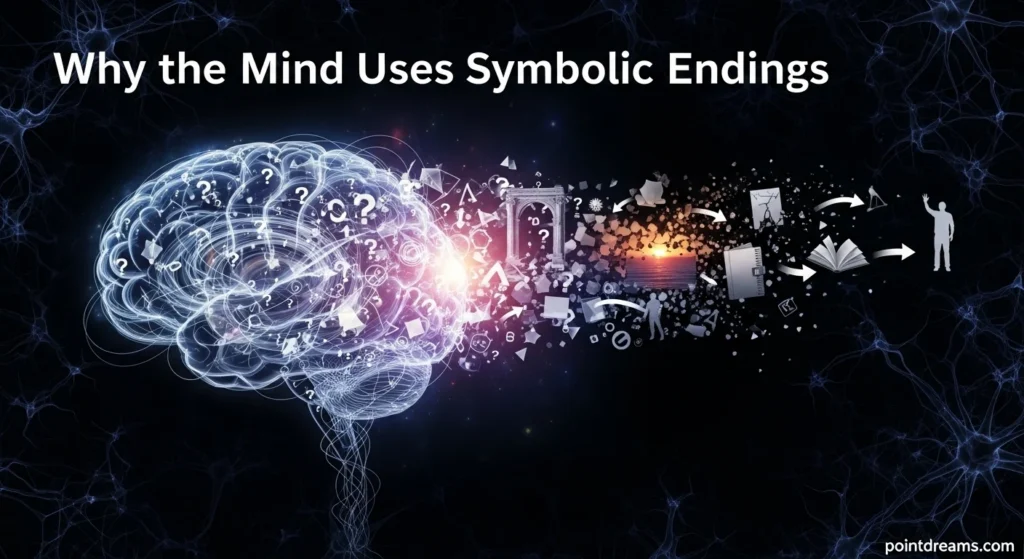
The subconscious rarely communicates directly. Instead, it uses symbols because emotions are complex and often cannot be expressed through straightforward imagery.
Endings are especially powerful symbols because they naturally represent change, transition, and emotional completion.
Emotional efficiency of symbols
A single image—like a closing door—can represent entire emotional chapters more efficiently than words.
Safe emotional processing
Symbolic endings allow the mind to explore difficult transitions without overwhelming the dreamer.
Internal vs external change
Not all endings in dreams reflect external events. Many represent internal emotional shifts, such as letting go of beliefs, fears, or identity patterns.
For example, ending a conversation in a dream may symbolize acceptance of emotional truth rather than an actual relationship ending.
The mind chooses symbolic endings because they allow emotional processing to happen gently and gradually.
Endings in Dreams vs Real-Life Change
One of the most important distinctions in dream interpretation is the difference between symbolic endings and literal life predictions.
Dreams rarely forecast actual events. Instead, they reflect emotional responses to change—whether that change has already happened, is happening, or is being anticipated.
When dreams reflect past change
You may dream of endings long after something has already concluded. This often means emotional processing is still ongoing.
When dreams reflect current transition
During life changes—moving, ending relationships, shifting careers—dreams often mirror emotional adjustment.
When dreams reflect anticipated change
Sometimes the mind prepares for possible endings, even if they have not yet occurred.
Symbolic endings are less about “what will happen” and more about “what your mind is adapting to.”
Common Symbolic Endings and Their Meanings
1. Closed doors
A closed door often represents emotional boundaries, completed chapters, or inaccessible parts of the past.
2. Departing trains or vehicles
These frequently symbolize missed opportunities, transitions, or moving forward in life.
3. Disappearing people
This can reflect emotional distancing, acceptance of separation, or internal release.
4. Ending conversations
These often represent unresolved thoughts reaching a point of emotional closure.
5. Fading environments
A dissolving house, street, or landscape may symbolize shifting identity or outdated emotional frameworks.
Each of these endings reflects a different layer of emotional transformation rather than literal loss.
Emotional Endings and Relationship Processing
Relationships are one of the most common sources of symbolic endings in dreams. However, these do not always relate to current relationships—they often reflect emotional processing of past connections or internal attachment patterns.
Ending romantic connections
Dreams of breakup scenarios or separation may reflect emotional integration rather than actual desire or regret.
Ending friendships
Friendship endings in dreams often symbolize shifting emotional priorities or evolving identity.
Ending family dynamics
These dreams may reflect emotional maturity, boundary setting, or unresolved family emotions.
Example scenario
You may dream of walking away from someone you care about without conflict. This often symbolizes acceptance rather than rejection.
Relationship endings in dreams are not about erasing connection—they are about transforming emotional meaning.
Internal Identity Endings
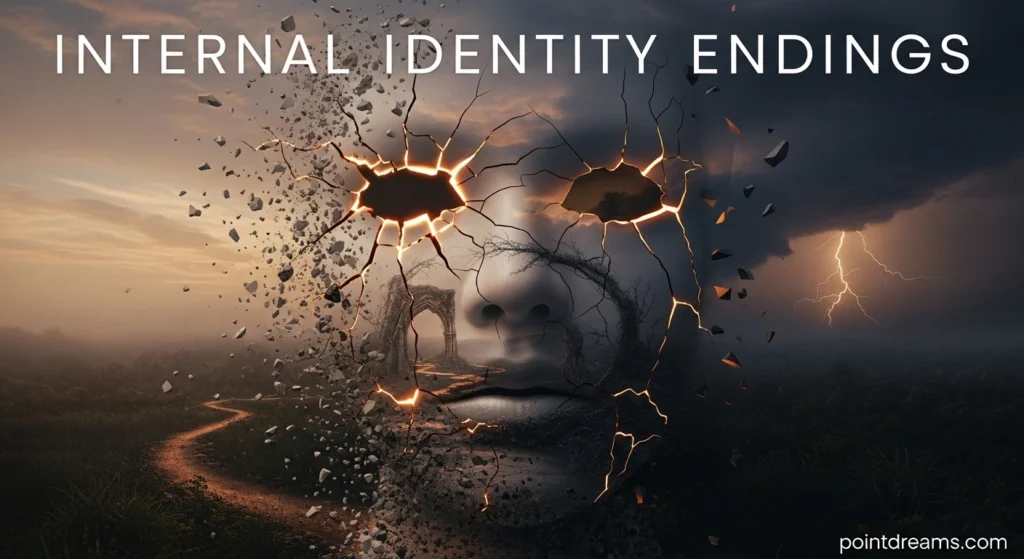
Not all symbolic endings involve other people. Many reflect internal identity changes—parts of yourself that are evolving, fading, or being redefined.
These are some of the most important but often overlooked dream endings.
Old self fading away
This can represent growth, maturity, or shifting values.
Abandoning old roles
You may dream of leaving behind roles like student, worker, caregiver, or partner.
Emotional belief endings
Sometimes the “ending” is not a person or place, but a belief system—fear, insecurity, or self-doubt dissolving.
Example insight
A dream where you walk away from an old version of your life often reflects psychological transformation rather than loss.
These endings are powerful because they signal internal evolution.
The Role of Closure in Symbolic Endings
Closure is one of the most important psychological functions of dream endings. When life does not provide emotional closure, dreams often create it symbolically.
Closure in dreams is not about rewriting reality—it is about emotional completion.
Why closure is needed
The mind resists unfinished emotional narratives. Without closure, emotional energy remains active.
Symbolic resolution
Dreams may show conversations ending peacefully, doors closing gently, or distance becoming accepted.
Emotional acceptance
Closure in dreams often feels calm rather than dramatic. This indicates emotional integration rather than conflict.
Closure does not mean forgetting—it means releasing emotional tension tied to memory.
When Endings Feel Painful in Dreams
Not all symbolic endings feel peaceful. Some are emotionally intense, filled with sadness, resistance, or confusion.
This emotional intensity often reflects unresolved attachment or fear of change.
Why painful endings occur
- Resistance to letting go
- Unprocessed grief
- Fear of uncertainty
- Emotional attachment to the past
Example scenario
Dreaming of losing someone repeatedly may reflect difficulty accepting emotional distance or change.
Emotional purpose
Painful dream endings are not harmful—they highlight areas where emotional acceptance is still developing.
These dreams often soften over time as emotional processing continues.
Sudden vs Gradual Endings in Dreams
Sudden closures—like instant disappearance or abrupt separation—often reflect shock, unresolved emotional disruption, or unexpected life changes.
Gradual endings
Slow fading, gentle departure, or fading environments often represent natural emotional transition and acceptance.
Emotional interpretation
- Sudden endings = emotional intensity or unresolved shock
- Gradual endings = integration and acceptance
The pace of the ending often reflects the emotional pace of processing in waking life.
Recurring Symbolic Endings and What They Indicate
When symbolic endings repeat in dreams, it usually means emotional processing is ongoing.
The mind revisits the same symbolic structure until emotional meaning is fully integrated.
Why repetition happens
- Emotional resistance
- Unfinished processing
- Persistent attachment
- Ongoing life transition
Example pattern
Repeated dreams of doors closing may indicate difficulty accepting change or emotional separation.
When repetition fades
As emotional understanding improves, recurring endings usually become less intense or disappear entirely.
Repetition is not stagnation—it is emotional refinement.
How Life Changes Trigger Dream Endings
Real-life transitions strongly influence symbolic endings in dreams. Even subtle changes can activate deep emotional processing.
Major life transitions
- Breakups
- Relocation
- Career shifts
- Loss or grief
Subtle internal changes
- Changing values
- Emotional growth
- Identity shifts
- New self-awareness
Emotional adaptation
Dreams help the mind adjust to these changes by symbolically “ending” old emotional structures.
Even positive change can trigger symbolic endings because the mind must let go of old stability.
Misunderstandings About Dream Endings
A common misconception is that dream endings predict real-life events. In reality, they reflect emotional states rather than external outcomes.
Misinterpretation 1: Literal prediction
A closing door does not mean opportunity loss—it often means emotional closure.
Misinterpretation 2: Negative meaning
Endings are not always bad. They often represent growth or transition.
Misinterpretation 3: External focus
Most dream endings are internal psychological processes, not external warnings.
Understanding these misconceptions helps you interpret dreams more accurately and calmly.
How to Work With Symbolic Endings in Dreams
1. Identify the emotion
Was the ending peaceful, sad, confusing, or relieving?
2. Connect to waking life
What current transition or emotional shift might this reflect?
3. Avoid literal interpretation
Focus on emotional meaning, not prediction.
4. Journal recurring themes
Tracking endings helps identify emotional patterns.
5. Allow emotional processing
Sometimes simply acknowledging the feeling is enough.
These practices help transform dream endings into tools for self-awareness.
The Healing Purpose of Dream Endings
Symbolic endings are not about loss—they are about transformation. They help the mind reorganize emotional experience so that growth can occur.
Without endings, emotional cycles remain open and unresolved. Dreams provide gentle closure where life may not.
Emotional integration
Endings help combine past experiences into a coherent emotional narrative.
Psychological release
They allow emotional energy to shift rather than remain stuck.
Personal evolution
Each symbolic ending often corresponds to a new phase of identity or awareness.
Healing is not forgetting the past—it is emotionally completing it.
Conclusion
Symbolic endings in dreams are powerful reflections of emotional change, inner growth, and psychological transition. Whether they appear as closing doors, fading people, or disappearing places, these images are not predictions but messages from the subconscious about how you are processing change.
They often signal emotional closure where life has provided none, or internal transformation where identity is shifting. While some endings feel peaceful and others feel painful, all serve the same purpose: helping the mind adapt, release, and evolve.
Understanding these dream endings allows you to see them not as confusing disruptions, but as meaningful steps in emotional healing. Each ending marks not just something being lost, but something being understood, integrated, and quietly transformed within you.
FAQs
1. Do symbolic endings in dreams mean something is ending in real life?
Not necessarily. They usually reflect emotional processing, not literal events.
2. Why do dream endings feel so emotional?
Because they process real emotional energy tied to memory and change.
3. What does a closed door mean in dreams?
It often symbolizes emotional closure or boundaries, not missed opportunities.
4. Why do I keep dreaming about endings?
Recurring endings suggest ongoing emotional transition or unresolved feelings.
5. Are dream endings a bad sign?
No. They often represent growth, healing, and emotional integration.
