
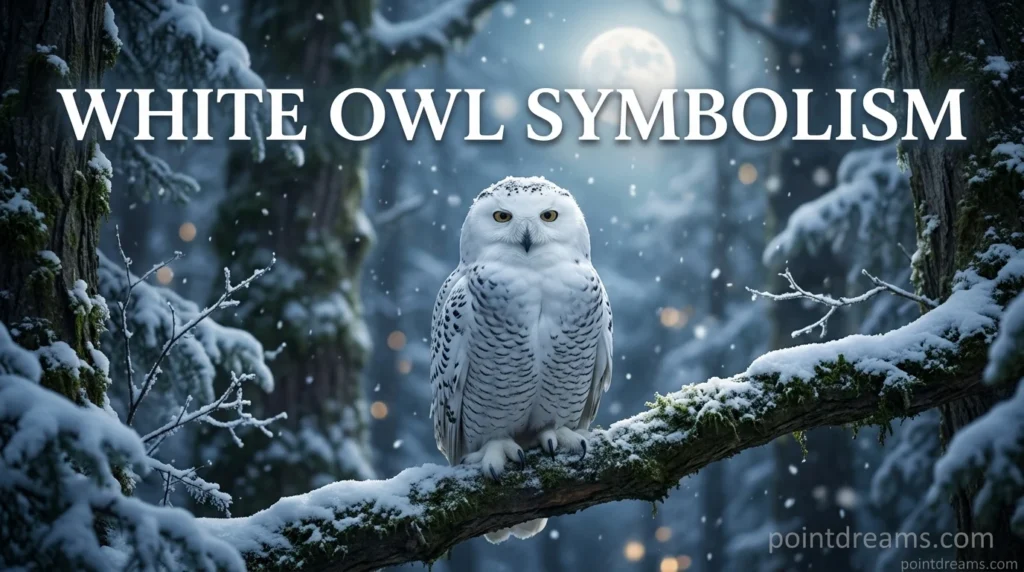
There are nights when grief does not arrive as tears or words, but as stillness. You may be sitting by a window, unable to explain the heaviness in your chest, when a white owl appears in your mind or dream—silent, pale, and almost luminous against the dark. It does not rush. It does not speak. It simply watches, as if it has come to stand beside something in you that is hurting but not yet ready to be named.
That is what makes white owl symbolism so powerful. Across many emotional and spiritual traditions, the white owl often appears as a messenger of transition, hidden truth, and quiet awareness. But when grief is involved, its meaning becomes even more intimate. It can reflect the part of you that is mourning in silence, the part that has not fully accepted loss, and the part that still searches for meaning in what feels unfinished.
Understanding white owl symbolism matters because grief rarely looks the way people expect. It can be subtle, delayed, private, and deeply layered. The white owl invites you to notice what your heart has been carrying quietly all along.
The White Owl as a Symbol of Quiet Witness
The white owl does not arrive with noise or spectacle. Its symbolism is rooted in silence, presence, and observation. That makes it feel especially connected to grief, because grief itself often lives in the quiet places of life. Not every loss is met with dramatic sorrow. Sometimes grief settles into the body like a low hum, present but unspoken.
A white owl can symbolize the part of you that is witnessing your pain without trying to fix it. It stands for awareness that is gentle rather than forceful. When someone is grieving, they often need exactly that: not pressure to “move on,” but permission to simply notice what is real.
The whiteness of the owl adds another layer. White can suggest purity, clarity, or spiritual presence, but it can also carry the feeling of emptiness, like a blank page after something has been erased. In that sense, the white owl may reflect grief as a form of quiet space left behind after loss. It is not a symbol of loud despair. It is a symbol of standing still with what remains.
This is why the white owl often feels comforting even when it is unsettling. It reminds you that grief does not always need explanation to be valid. Sometimes, being witnessed is the beginning of healing.
Why Grief Often Appears in Symbolic Forms

Grief is rarely direct. The mind often processes it through images, dreams, sensations, and symbols because feelings that are too large for language need another form of expression. A white owl can become one of those forms. It gives shape to something that might otherwise remain vague and hard to name.
When people lose someone they love, or even lose an identity, a dream, a season of life, or a sense of safety, the emotions involved can be too layered for simple statements. You may not say, “I am grieving,” but your inner world may still be trying to communicate that truth. Symbols bridge the gap between what is felt and what is understood.
The mind speaks indirectly
Instead of saying “I am sad,” the mind may present a white owl: something calm, watchful, and mysterious. This allows grief to appear in a form that feels less threatening, making it easier to approach.
Symbols soften emotional truth
The white owl does not demand immediate interpretation. It invites reflection. That softness can be important when pain feels too raw to face directly.
Grief seeks meaning
After a loss, people naturally look for patterns, signs, and reassurance. A symbol like a white owl may reflect that search, offering a sense that the inner world is still trying to find order in the absence.
In this way, white owl symbolism becomes less about superstition and more about emotional translation. It helps the heart speak when words feel too small.
1. The White Owl Reflects Unspoken Sadness
One of the clearest ways white owl symbolism connects to inner grief is through unspoken sadness. This is the sadness that does not always show up as crying. It may look like fatigue, silence, distraction, or a constant sense that something is missing.
The white owl is a fitting symbol for this because it is quiet and observant. It does not crash into a scene. It appears softly, often at the edge of awareness. That mirrors how hidden grief behaves in daily life. You may be functioning well on the outside while carrying a private sadness that no one else can see.
A grief that hides in routine
A person may go to work, answer messages, and finish tasks while carrying the ache of a loss that has not been fully processed. The white owl represents that invisible layer of emotion.
The sadness that waits
Sometimes grief is postponed because life requires endurance. The white owl can symbolize the sadness waiting patiently until there is finally room for it to be acknowledged.
The value of gentle recognition
Seeing this symbol in a dream, meditation, or reflective moment can be an invitation to stop and ask, “What sadness have I not given language to yet?”
Unspoken sadness does not mean weak grief. It often means deep grief. The white owl honors that depth by appearing without judgment, as if it knows your sorrow does not need to be loud to be real.
2. The White Owl Reflects the Presence of Absence
Grief is not only about pain. It is also about absence—the chair that stays empty, the message that never comes, the routine that no longer has its center. White owl symbolism often reflects this strange emotional experience of feeling the presence of someone or something that is no longer physically there.
The owl’s appearance in silence can mirror the way absence occupies a space. You may go through your day and still feel the weight of what is missing. The white owl becomes a symbol of that weight: invisible, yet unmistakable.
When memory feels alive
A scent, a place, or a sound can suddenly bring someone back in feeling, even when they are gone. The owl reflects this haunting kind of presence.
The shape left behind
Loss often changes the emotional architecture of life. The owl may symbolize the outline of what once was, now visible only through what has been removed.
Learning to live with the gap
The white owl does not erase absence. It acknowledges it. This matters because healing does not always mean filling the empty space. Sometimes it means learning how to sit beside it without being destroyed by it.
This symbolism can be deeply comforting. It tells you that what you feel is not strange. The absence itself is part of the mourning process, and your heart is simply noticing what has changed.
3. The White Owl Reflects Hidden Wisdom in Pain
Grief feels like loss, but it can also open a strange door to insight. White owl symbolism often carries the idea that pain contains wisdom, even when it is not immediately visible. The owl is traditionally associated with perception, and the white owl in particular suggests a more refined, almost spiritual kind of seeing.
That does not mean grief is good or that suffering is secretly a gift. It means that pain can reveal what was previously overlooked. People often understand their values, attachments, and vulnerabilities more clearly after loss. The white owl stands for that kind of knowing.
What grief teaches quietly
You may discover which relationships truly sustained you, what parts of life you took for granted, or where your emotional boundaries need care.
Wisdom without rush
The owl does not rush toward conclusions. That matters because grief cannot be neatly solved. Insights often arrive slowly, in fragments.
Seeing more clearly
After loss, some people notice they are more honest, more tender, or more aware of what matters. The white owl can symbolize this sharpened vision.
The wisdom in grief is not always pleasant. Sometimes it comes through disillusionment. Sometimes it comes through humility. But the white owl suggests that even in pain, the soul can become clearer, more attentive, and more deeply awake.
4. The White Owl Reflects Emotional Isolation
Grief can be lonely, even when people are around. There are moments when no one quite understands the shape of your loss, and you may feel separated from the world by an invisible glass wall. White owl symbolism often reflects this emotional isolation.
Owls are solitary by nature, and a white owl especially can feel like a lone figure moving through darkness. This does not make it cold. It makes it honest. Some grief is deeply private. It cannot be fully explained or shared because it belongs to a place inside you that words do not reach.
The loneliness of being changed
After loss, even familiar places can feel altered. You may be surrounded by people yet still feel alone in what you carry.
The silence of being misunderstood
Friends may want to help, but they may not know what to say. The owl mirrors that quiet disconnect.
A loneliness that deserves compassion
Isolation can lead people to believe they are failing at grief. The white owl suggests otherwise. It shows that solitude is sometimes part of mourning, not a sign that something is wrong.
This symbolism can be painful, but it can also be validating. It tells you that the loneliness of grief is real, and that being alone with your feelings does not mean being abandoned by them.
5. The White Owl Reflects Transition and Thresholds
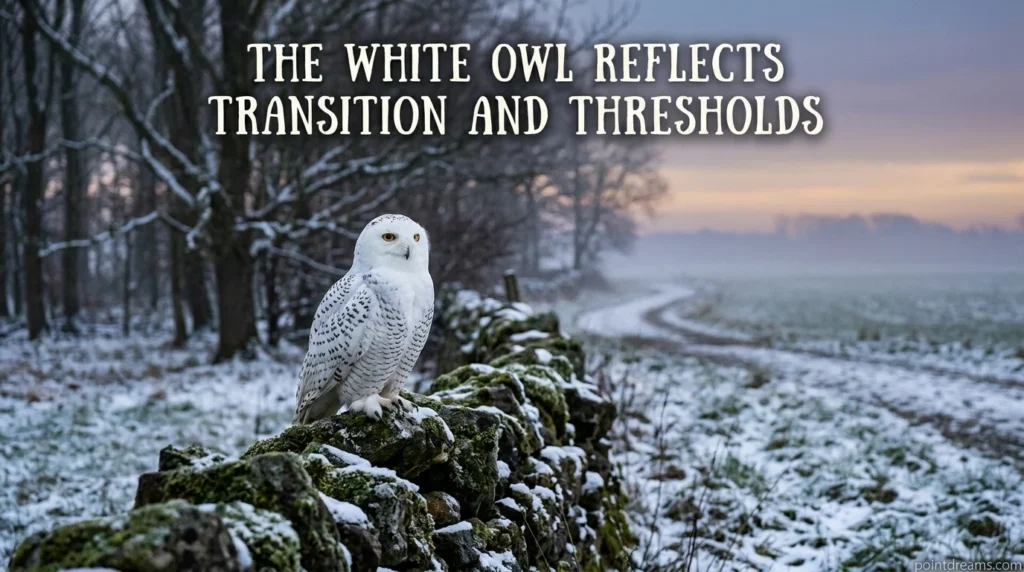
Grief often places you on a threshold. Something has ended, but something new has not yet fully begun. The white owl is a powerful symbol of that in-between state. It appears in liminal spaces: dusk, dawn, the edge of visibility, the place between one world and another.
That makes it especially meaningful for people navigating loss. You may not be who you were before, but you are not yet sure who you are becoming. The white owl stands in that uncertain passage.
The in-between season
After a loss, life may feel suspended. You are no longer in the old chapter, but you have not settled into the next one.
The fear of what comes next
Thresholds can be unsettling because they require surrender. The white owl reminds you that uncertainty is part of the journey.
Movement without certainty
The owl does not need perfect visibility to move forward. That is a lesson many grieving people need to hear. Healing often happens without full clarity.
This symbolism can be especially useful when grief feels like a long pause. The white owl suggests that pause is not emptiness. It is transition. It is the quiet crossing from one self into another.
The White Owl in Dreams and Personal Moments
When the owl appears in a dream
If you dream of a white owl during a period of loss, it may represent your inner self trying to communicate something important. Perhaps you are being asked to pay attention to a feeling you have ignored, or to notice a truth about your grief that you have not yet admitted.
When the owl appears in waking life
For some, seeing a white owl in nature or in art during a difficult season can feel deeply moving. Whether taken spiritually or psychologically, the experience can become a marker of reflection. It may arrive at the exact moment you need to slow down and listen inward.
Why the moment matters more than the symbol alone
The meaning of the owl is shaped by context. A peaceful sighting in a hard season may feel comforting. A dream in which the owl watches from a distance may feel more like a call to self-examination. In either case, the symbol gains meaning through your emotional reality.
This is where white owl symbolism becomes personal. It is not just about the owl. It is about what the owl awakens in you.
The Difference Between Comfort and Warning
White owl symbolism can hold both reassurance and caution. That duality makes it especially rich. In some moments, it feels like a gentle presence. In others, it may feel like a reminder that something within you needs attention.
This does not mean the symbol is negative. It means grief itself is complicated. It can comfort you one moment and unsettle you the next.
When it feels comforting
The owl may suggest that you are not alone in your mourning. It can represent inner wisdom, spiritual presence, or a quiet sense that your pain is being witnessed.
When it feels unsettling
The owl may indicate that you have been avoiding a truth. Perhaps your grief is deeper than you have allowed yourself to admit.
Learning from both
The power of the symbol lies in holding both meanings at once. Grief often does that too. It comforts because it connects us to love, and it hurts because it reveals absence.
The white owl teaches that emotional truth is rarely one-dimensional. Healing often begins when you stop forcing symbols, and instead let them be complex enough to match your experience.
6 Ways the White Owl Mirrors Inner Grief
White owl symbolism can reflect inner grief in at least six meaningful ways. These are not rigid rules, but compassionate interpretations that can help you recognize what the symbol may be showing you.
1. It reflects silence
Grief often becomes quiet, especially when people do not know how to express it.
2. It reflects absence
The owl can stand in for what is missing, reminding you that loss changes the emotional landscape.
3. It reflects hidden insight
Pain can reveal truths that comfort never could. The owl carries that kind of clear seeing.
4. It reflects solitude
Some grief must be carried alone for a time. The owl honors that solitude without shaming it.
5. It reflects transition
Loss moves you from one life into another, often without clear boundaries. The owl marks that threshold.
6. It reflects sacred attention
Even if you do not interpret the symbol spiritually, it can still represent the deep attention your inner self is asking for.
These six reflections make the white owl a powerful symbol of grief’s many layers. It is not just a sign of sorrow. It is a sign that your sorrow has depth, meaning, and a place in your healing.
How to Work With the Symbol in Everyday Life

If the white owl appears to you repeatedly, the best response is not to force a single meaning. Instead, treat it as an invitation to listen. Symbols become helpful when they lead to reflection, not fear.
You might begin by asking what part of your grief feels most present right now. Is it loneliness? Regret? Missing a person? Feeling changed by something you cannot undo? The white owl may not answer directly, but it can help you slow down enough to hear your own heart.
A simple practice
Write down when the symbol appears, how it makes you feel, and what was happening emotionally around that time. Over time, patterns may emerge.
A grounding question
Ask yourself: “What am I being asked to notice that I have avoided?”
A compassionate response
Instead of judging your grief, acknowledge it. Quiet grief often grows heavier when ignored and lighter when witnessed.
Working with symbolism in this way can turn the white owl from an abstract image into a deeply personal guide. It becomes a mirror rather than a mystery.
Common Misunderstandings About White Owl Symbolism
It is easy to misunderstand a symbol like the white owl by reducing it to either pure good luck or pure warning. But grief does not fit that kind of simplicity, and neither does the owl.
One common mistake is assuming the symbol must predict something external. In reality, its strongest meaning may be internal. It can reflect a state of heart rather than a future event.
Another misunderstanding is thinking that grief must always look dramatic. The white owl reminds us that some of the deepest grief is quiet, private, and ongoing.
A third mistake is treating symbolism as universal in a rigid way. While white owls often carry similar themes, your personal relationship to the symbol matters. What it means for one person may not match what it means for another.
The most helpful approach is not certainty, but curiosity. When you hold the symbol gently, it can reveal what is true without forcing it into a box.
Turning the Symbol Into a Path Toward Healing
The value of white owl symbolism is not just in interpretation. It is in what it can help you do.
Healing does not require dramatic breakthroughs. Sometimes it begins with a moment of recognition. You see the owl, remember the loss, and realize your heart has been asking for attention. That moment can become a turning point.
The white owl does not erase grief. It does something gentler and perhaps more useful: it helps you stay present with grief without becoming lost in it. That presence is a form of care. It allows you to move slowly, honestly, and with more self-compassion than before.
The path forward is not to stop grieving, but to grieve with greater awareness. That is where the symbol becomes more than an image. It becomes a companion.
Conclusion
White owl symbolism carries a quiet but powerful connection to inner grief. It reflects the sadness that hides beneath daily routines, the absence that reshapes life, the wisdom that pain can slowly reveal, and the solitude that so often accompanies mourning. It also marks the threshold between what has ended and what is still becoming.
For many people, the white owl appears as a gentle witness rather than a forceful message, offering a sense that grief does not need to be loud to matter.
Its presence invites reflection, compassion, and patience. When you meet this symbol with openness, it can help you understand your grief more clearly and begin to move through it with a steadier heart. Sometimes healing starts not with answers, but with a quiet moment of recognition.
FAQs
1. What does a white owl symbolize in grief?
It often symbolizes quiet sorrow, hidden pain, transition, and the need for gentle awareness.
2. Is seeing a white owl a spiritual sign?
It can be interpreted spiritually by some people, but it may also reflect personal emotional processing.
3. Why do white owls feel connected to loss?
Their silence, stillness, and appearance at the edge of visibility make them feel like symbols of hidden grief.
4. Does the white owl always mean something negative?
No. It can also represent wisdom, comfort, and the beginning of healing.
5. How should I respond if I keep noticing white owl symbolism?
Pause and reflect on what grief or emotional truth may be asking for your attention.
